ProjectManagement
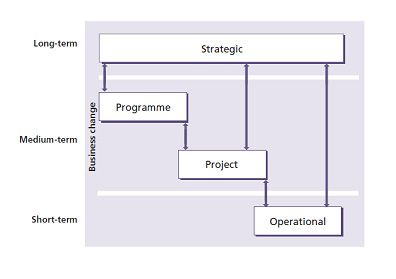
A project is a temporary organisation. In an organisational context, projects are the means by which we introduce change.

What is a project?
Project management is the planning, delegating, monitoring and control of all aspects of the project, and the motivation of those involved, to achieve the project objectives within the expected performance targets for time, cost, quality, scope, benefits and risk.
The two leading project management approaches world-wide are probably PRINCE2 (which was developed by the UK Office of Government Commerce) and PMBOK (the Project Management Body of Knowledge, developed by the Project Management Institute in the USA). We utilise both of these resources in the provision of our own project management services. The differences between a method (such as PRINCE2) and a body of knowledge (such as PMBOK) make them highly complementary. PRINCE2 provides a framework of what needs to be done, by whom and by when. The BOK provides a range of techniques of how these things can be done.
The explanatory comments immediately below are taken from Managing Successful Projects with PRINCE2 (2009) and from the Wikipedia entry for A Guide to the Project Management Body of Knowledge.
The importance of projects
A key challenge for organisations in today’s world is to succeed in balancing two parallel, competing imperatives:
- To maintain current business operations – profitability, service quality, customer relationships, brand loyalty, productivity, market confidence etc. What we term ’business as usual’
- To transform business operations in order to survive and compete in the future – looking forward and deciding how business change can be introduced to best effect for the organisation.
As the pace of change (technology, business, social, regulatory etc.) accelerates, and the penalties of failing to adapt to change become more evident, the focus of management attention is inevitably moving to achieve a balance between business as usual and business change. Projects are the means by which we introduce change – and, while many of the skills required are the same, there are some crucial differences between managing business as usual and managing project work.
What makes projects different?
A project is a temporary organisation that is created for the purpose of delivering one or more business products according to an agreed Business Case. There are a number of characteristics of project work that distinguish it from business as usual:
- Change : Projects are the means by which we introduce change
- Temporary : As the definition above states, projects are temporary in nature. Once the desired change has been implemented, business as usual resumes (in its new form) and the need for the project is removed. Projects should have a defined start and a defined end.
- Cross-functional : Projects involve a team of people with different skills working together (on a temporary basis) to introduce a change that will impact others outside the team. Projects often cross the normal functional divisions within an organisation and sometimes span entirely different organisations. This frequently causes stresses and strains both within organisations and between, for example, customers and suppliers. Each has a different perspective and motivation for getting involved in the change.
- Unique : Every project is unique. An organisation may undertake many similar projects, and establish a familiar, proven pattern of project activity, but each one will be unique in some way: a different team, a different customer, a different location. All these factors combine to make every project unique.
- Uncertainty : Clearly, the characteristics already listed will introduce threats and opportunities over and above those we typically encounter in the course of business as usual. Projects are more risky.
Why have a project management method?
Project management is the planning, delegating, monitoring and control of all aspects of the project, and the motivation of those involved, to achieve the project objectives within the expected performance targets for time, cost, quality, scope, benefits and risks.
It is the development of the project’s deliverables (known as ‘products’ in PRINCE2) that deliver the project’s results. A new house is completed by creating drawings, foundations, floors, walls, windows, a roof, plumbing, wiring and connected services. None of this is project management – so why do we need project management at all?
The purpose of project management is to keep control over the specialist work required to create the project’s products or, to continue with the house analogy, to make sure the roofing contractor doesn’t arrive before the walls are built. Additionally, given that projects are the means by which we introduce business change, and that project work entails a higher degree of risk than other business activity, it follows that implementing a secure, consistent, well-proven approach to project management is a valuable business investment.
What brought Business Generation and project management together? We plan for our clients to succeed. When we start a strategic planning assignment, we know what’s coming. We know that mission-critical issues will be identified, and that effective strategies will then be developed to address them. We know that those strategies will take the shape of transformational projects. We know that effective strategy deployment depends, more than anything else, on effective project management. (It follows that the risk management plan of any organisation should include a rigorous assessment of its own capability in project management.)
Our Project Management Services
Our contributions in the project management area include the following:
- explaining to our clients the complementary nature of business as usual and transformational change, and the complementary but fundamentally different nature of the relevant management processes;
- assisting organisations to establish or enhance formal project management systems and processes, including suggesting training options and mentoring relevant executives;
- contributing process expertise and pro formas that assist in the initial description, subsequent elaboration and ongoing assessment of candidate projects (whether emerging through the strategic planning process or elsewhere);
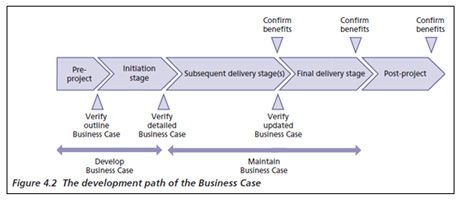
- preparation of business cases, whether this be the outline business case that is part of an initial project brief, or the detailed business case that is required for investment approval, or the revalidated business case that should precede every successive stage of a major project;
Introducing PRINCE2
What it is PRINCE2 is a widely adopted, non-proprietary project management method used across industries and countries.
Why it works It is deliberately generic, meaning it can be applied to projects of any size, type, organisation, geography, or culture.
How it’s structured PRINCE2 separates project management from specialist work (such as design, construction, or IT). Specialist methods plug into PRINCE2 without disrupting the overall framework.
Role of the Project Manager The Project Manager plans the work, delegates tasks, monitors progress, and takes corrective action when needed. The focus is on keeping the project under control rather than doing the specialist work.
How control is achieved PRINCE2 ensures the right information reaches the right people at the right time so informed decisions can be made.
What is controlled PRINCE2 manages six key project variables:
- Cost – keeping the project affordable
- Time – managing delivery dates
- Quality – ensuring outputs are fit for purpose
- Scope – clearly defining what is and isn’t included
- Risk – understanding and managing uncertainty
- Benefits – ensuring the project delivers value
Organisational value When adopted as a standard, PRINCE2 improves organisational capability and maturity across areas such as business change, IT, construction, mergers and acquisitions, research, and product development.
Introducing PMBOK
What it is The PMBOK Guide is a process-based framework developed by the Project Management Institute to guide project management best practice.
Core approach Work is described through processes made up of:
- Inputs (plans, documents, designs)
- Tools and techniques
- Outputs (deliverables, reports)
How it’s structured The Guide defines 42 processes organised into:
- Five process groups: Initiating, Planning, Executing, Monitoring & Controlling, Closing
- Nine knowledge areas covering the key disciplines of project management
Knowledge areas covered Integration, Scope, Time, Cost, Quality, Human Resources, Communications, Risk, and Procurement.
How processes relate Each process belongs to both a process group and a knowledge area, forming a matrix that shows how work flows across the project lifecycle.
Purpose of the guide PMBOK provides a general reference framework intended to support most projects, most of the time, rather than a prescriptive method.
What about Leadership capability?
Leadership, motivational skills and other interpersonal skills are immensely important in project management but impossible to codify in a method. Leadership styles vary considerably and a style that works in one situation may be entirely inappropriate in another. The fact that it is easy to think of successful leaders who have adopted very different styles – from autocratic to consensus-based – bears this out. For this reason, PRINCE2 and PMBOK cannot address this aspect of project management directly. There are many leadership models and interpersonal skills training programmes that do fulfil this requirement.
What part do we play in project management?
Our principal interest in Project Management is as a vital enabler to strategy deployment. We can contribute relevant support as appropriate to your circumstances:
- by providing a virtual Project Management Office (PMO), for organisations that prefer to outsource that function;
- through participation on a project board, whether as the Project Executive or on the buyer or supplier side; and
- via project management itself, for specific projects.
We plan for our clients to succeed
We believe in strategic planning, because it dictates transformational change and thereby underwrites the future performance of an organisation. We believe in project management because it ensures that the desired change are actually implemented.
In strategic planning, deployment is the main site of failure. Now you know why.

Ready to talk it through?
Get in touch and we'll help you find the right approach for your organisation.
Or you can email us direct:
- Email:
- adrian@businessgeneration.com.au
- Phone:
- +61 2 9964 9333